

MAGAZINE FALL 2025
By Carole Reinert
When Kyle Wyche (MBA ’24, A&S ’19) was a little boy, he loved to wrap maple seeds in damp paper towels, put them in sandwich bags, blow air into the bag, and watch the seeds grow. Today, as co-founder of Ecotone Renewables, a company dedicated to reducing food waste, his passion for nature has come full circle.
As a freshman at the University of Pittsburgh, Wyche considered a triple major in environmental science, biology, and astronomy, all while on the medical school track, unsure of his career plans.
“When asked what I wanted to do when I grew up, I always responded that my job doesn’t exist yet,” he says.
Realizing how long it would take to earn three degrees, Wyche quickly turned astronomy into a hobby and combined his interests in biology and environmental science to graduate with a degree in ecology and evolution, with a minor in chemistry. If all else failed, he knew he had enough science classes to attend medical school and become a physician, like his parents.
As it turns out, he didn’t need a backup plan. His undergraduate degree gave him the connections to start a company, and his MBA helped expand the company internationally.
Class Project Grows into a Company
In 2017, Wyche was one of the students from Pitt, Michigan, and Carnegie Mellon universities who developed an aquaponics system that became Pittsburgh’s first portable farm. This project didn’t proceed; yet it connected Wyche with Dylan Lew.
Knowing that approximately eight percent of global greenhouse gas emissions come from landfills, they brainstormed ways to reduce food waste going to landfills.
Lew tapped into his engineering background to create Zero Emissions Upcycling System (ZEUS), an anaerobic food digestion system. Food waste goes into ZEUS, which converts the waste into an organic liquid fertilizer called Soil Sauce. In 2019, Elliott Bennett joined Wyche and Lew, and they incorporated Ecotone Renewables. They later transformed the company into a public benefit corporation.
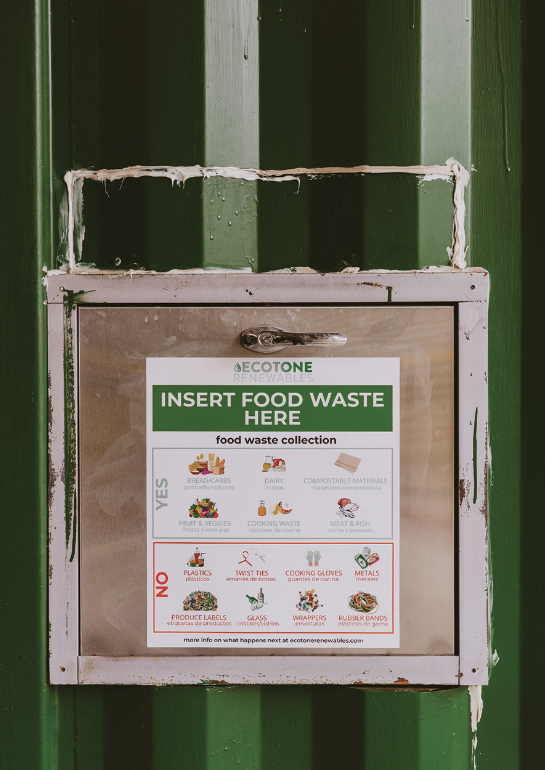
ZEUS fits into a shipping container and is easy to use. A person puts the food waste into a slot and simply walks away.
“By building a company that can adapt through strategy, structure, systems, and leadership style, business leaders can plan for the future.”
MBA Provides Business Insights
Wyche’s MBA has a concentration in sustainable business and data programming. He’s surprised by how much of his classwork applies to his work at Ecotone Renewables.
“I feel like every single class I’ve taken can be used someday for Ecotone,” he says. “Since we are a manufacturing company, the Six Sigma class helps me understand how to make the company leaner, and the finance classes complement my science background.”
Wyche believes having an MBA helps him communicate better, saying that, “sometimes those who are very science-minded don’t know how to present their findings in a way that can be understood. Plus, knowing how to market yourself is helpful.”
The Business of Humanity course, taught by John Camillus,was his favorite.
Turning Waste Into Wins
Over the last two years, the founders of Ecotone Renewables have transformed from bold student innovators to nationally recognized changemakers in the fight against climate change.
Momentum started to build in 2023, when the startup secured a $300,000 grant to help the University of Pittsburgh reach carbon neutrality by 2037. The ZEUS compact anaerobic digesters were installed on campus to convert 10 tons of food waste into renewable energy and nutrient-rich fertilizer. This will divert an estimated 120 tons of CO₂ emissions per system each year.
Currently, there is one ZEUS digester deployed on the Oakland campus, and more are scheduled to be installed in Oakland and across Pitt’s four branch campuses. In a two-month span, the anaerobic digester at Posvar Hall diverted 544 pounds of organic material.
That same year, the company was a finalist in a business pitch competition at the National Black MBA Association Conference.
By September 2024, Co-founders Wyche and Lew were pitching to a crowd of 200 corporate executives at Compass Group’s Pitch to Pilot Competition. Their vision for transforming global food waste management earned them a $20,000 prize and a paid pilot to ship ZEUS to Toronto, launching their first international partnership with Compass Group, a food service and hospitality company.
The recognition for the company didn’t stop there. In December, all three co-founders were named to the Forbes 30 under 30 in the Energy & Green Tech category. According to Forbes, “Ecotone has raised over $4 million in funding, diverted 200,000+ pounds of food waste from landfills, deployed eight ZEUS across Pennsylvania and Rhode Island, and increased production efficiency through optimized processes.”
As of July 2025, the company has deployed 12 ZEUS digesters across the country, with the most recent being in Rincon Valley, California.

The Future: Circular, Profitable & Sustainable
Turning food waste into fertilizer to grow more food benefits both the environment and the bottom line. Currently, Ecotone Renewables has 13 full-time employees. In addition to having food digesters on Pitt’s campus,
their clients include Bryant University, the City of Pittsburgh, Allegheny Health Network, Meta, Amazon, Rye Country Day School, Mercy Health Network, and Penn Hills Charter School, to name a few.
While he enjoys managing the day-to-day operations at Ecotone, Wyche still likes the hands-on experience that comes from nurturing plants.
He started Kyle’s Terraria as a side gig while he was an undergrad, and it evolved into a company. He gives presentations to garden clubs and sells terrariums at home and garden shows and art shows. One of the terrariums he designed won second place at the Philadelphia Flower Show this past March.
In 2015, Wyche walked onto Pitt’s campus with a love for this planet. Now, a decade later, he has two degrees, experience, and connections to help improve the planet’s health by reducing the effects of climate change.
